
























-
Viborg Shirt Olaf Natural -
Wool Tunic Lodin Grey -
Wool Tunic Lodin Dark Grey -
Medieval Tunic / Wool Tunic “Lodin“ - Red -
Wool Tunic Lodin Green -
Wool Tunic Lodin Blue -
Wool Tunic Lodin Brown -
Medieval Tunic / Under Tunic “Leif“ - Blue Medieval Tunic / Under Tunic “Leif“ - Blue
$39.99 USDMedieval Tunic / Under Tunic “Leif“ - Blue
$39.99 USD -
Under Tunic Leif Hemp -
Medieval Tunic / Under Tunic “Leif“ - Black Medieval Tunic / Under Tunic “Leif“ - Black
$39.99 USDMedieval Tunic / Under Tunic “Leif“ - Black
$39.99 USD -
Medieval Tunic / Under Tunic “Leif“ - Natural Medieval Tunic / Under Tunic “Leif“ - Natural
$39.99 USD -
Long Tunic Everard Black -
Long Tunic Arnaud Natural -
Long Tunic Arnaud Grey -
Under Tunic Gilbert Natural -
Long Under Tunic Bernard Natural -
Tunic Ekwin Black -
Medieval Tunic “Ekwin“ - Red -
Tunic Ekwin Brown -
Braies Gisbert Natural -
Surcoat Ivrea Camel -
Surcoat Leonora Dark Blue -
Skjoldehamn Cowl Bjorn Grey -
Skjoldehamn Cowl Bjorn Brown -
Skjoldehamn Cowl Bjorn Autumn Green -
Skjoldehamn Cowl Knud Herringbone Black/Grey Skjoldehamn Cowl Knud Herringbone Black/Grey
$45.99 USDSkjoldehamn Cowl Knud Herringbone Black/Grey
$45.99 USD -
Skjoldehamn Cowl Knud Herringbone Olive/Grey Skjoldehamn Cowl Knud Herringbone Olive/Grey
$45.99 USDSkjoldehamn Cowl Knud Herringbone Olive/Grey
$45.99 USD -
Skjoldehamn Cowl Knud Herringbone Burgundy/Grey Skjoldehamn Cowl Knud Herringbone Burgundy/Grey
$45.99 USD -
Bonnet Emma Natural -
Bonnet Emma Bordeaux -
Bonnet Helga Natural -
Bonnet Helga Black


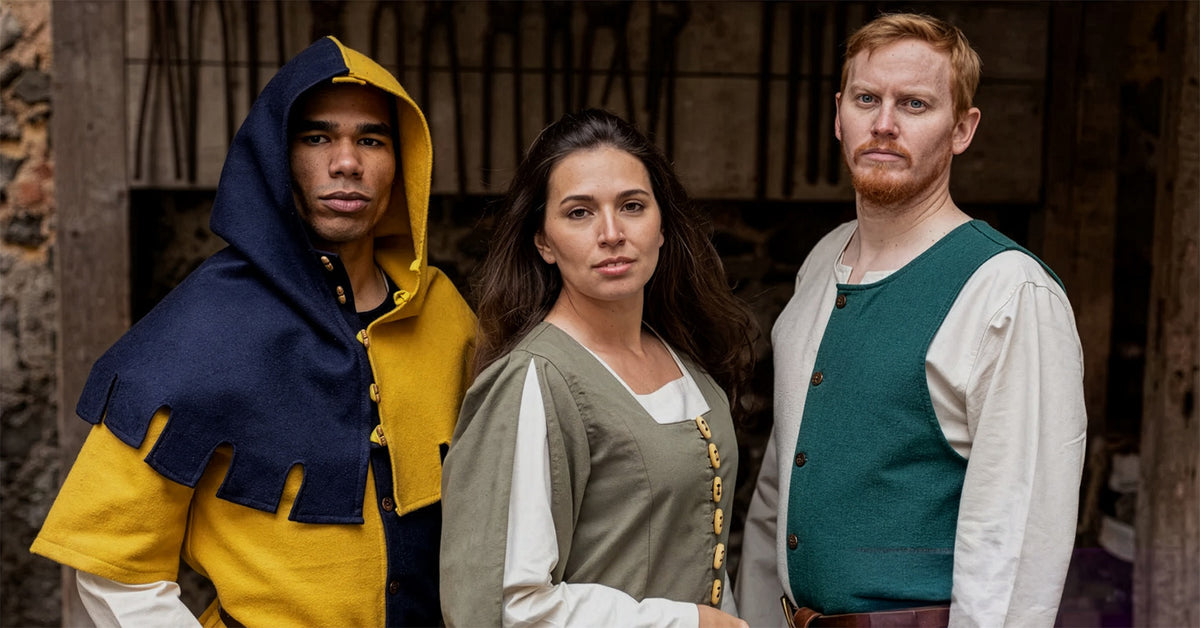
The High Middle Ages usually designate the time from the 11th to the 13th centuries. Most notably, compared to the Early Middle Ages, during the the High Middle Ages the garments of the nobility had become far more conspicuous, more colorful, and form-fitting.
According to contemporary research, the most common clothing item was the “cote,” a rather simple garment worn by rich and poor, men and women alike. However, the cote’s shape and color varied, depending upon the wearer’s gender and stratum.
The garments of the poor in the High Middle Ages
The simple shape of the cote was quite popular with the lower strata and it was frequently worn by the poor. So, for instance, the Landsässische Tracht (garb worn by Landsassen; Middle High German for ’farm workers’), usually consisted of an undershirt and breeches (a kind of medieval briefs) as undergarments under a belted cote and chauces, usually with a coif (‘Bundhaube’) as headwear, topped off with a hat or a hood. Farmers and simple peasants usually wore clothes made from wool or linen, as these materials were easy to produce and inexpensive to obtain.
Clothing of the nobility in the High Middle Ages
Because clothing in the High Middle Ages was also considered a symbol of status and the nobility fancied showing off their prosperity, obtaining the most exquisite fabrics quickly became quite a sumptuous affair. Although the pattern of the cote worn by the nobility resembled that of the peasants, the garment was hardly suitable for practical labor. Noble men usually wore cotes with varying lengths (from the middle of the thighs to the middle of the calves), while women’s dresses were often long enough to draggle on the floor. Additionally the rich attempted to use (and thus show off) as much fabric as possible and therefore pleated it vertically. As a result, the motif of the pleated garment was quite popular in the visual arts of that time.
Dyed fabrics were, due to the rarity of dyes, quite expensive, which is why the colorful garb of the nobility stood out from the untreated farbics worn by the lower strata.


