






























-
Right Side Surcoat Aleran Yellow -
Left Side Surcoat Aleran Blue -
Long Tunic Arnaud Natural -
Wool Tunic Lodin Brown -
Tunic Ekwin Brown -
Left Side Surcoat Aleran Black -
Left Side Surcoat Aleran Yellow -
Left Side Surcoat Aleran Natural -
Left Side Surcoat Aleran Green -
Right Side Surcoat Aleran Blue -
Right Side Surcoat Aleran Green -
Tabard Thibaud Black -
Long Tunic Arnaud Grey -
Right Side Surcoat Aleran Black -
Under Tunic Leif Seaweed -
Round Brooches Set Ingwaz Brass -
Bonnet Emma Natural -
Short Tunic Erik Natural -
Bonnet Helga Natural -
Long Tunic Everard Black -
Viborg Shirt Olaf Natural -
Hooded Long Tunic Renaud Grey -
Bundling Hood Wolfram Olive Green -
Under Tunic Leif Bordeaux -
Bundling Hood Wolfram Camel -
Wool Tunic Lodin Natural -
Bonnet Helga Hemp -
Bonnet Dagmar Natural -
Bonnet Emma Bordeaux -
Belt Hedwig Bordeaux -
Surcoat Ivrea Camel -
Surcoat Leonora Dark Blue


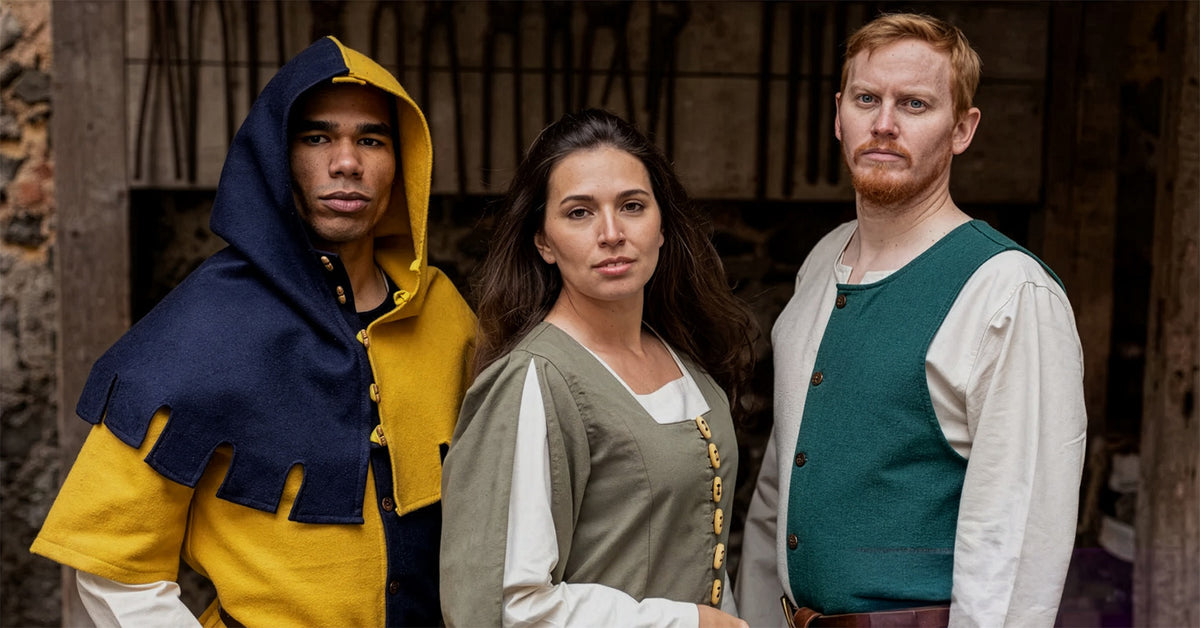
The tunic, made mainly from linen, wool or—more rarely—from silk for the more prosperous, was an essential element of clothing in the High Middle Ages.
During this period, it was primarily the cut of the tunic that changed. Nobles fancied their tunics to be more form-fitting, and started wearing them not just as undergarments—as had been customary in the Roman Empire—but as a distinct outer garment. Among the lower strata, however, the tunic remained wide and comfortable, because restrictive clothing was not practical for hard labor.
How sumptuary laws affected the tunic in the High Middle Ages
During the High Middle Ages, the lower strata—farmers, for instance—wore clothing made from far less opulent fabrics than did the nobility; hence, someone’s station in society was distinctly discernible from their clothing—and not just because most peasants could never afford the same colorful fabrics as the nobles, who deemed it important to set themselves apart from the rest of the populace. Therefore, sumptuary laws codified who was allowed to use which fabrics and colors and who wasn’t. Farmers, for instance, were forbidden to wear dyed garb; their fabrics had to remain untreated. So the nobles flaunted splendiferous, colorful tunics, while those of the peasants were left as simple and practical as possible.
Sources for tunics in the High Middle Ages
Unfortunately, neither tunics nor other textiles from the High Middle Ages were descried in sufficient amount; consequently, a great deal of knowledge about the appearance of that time still eludes us. The little we do know has been inferred mainly from paintings dating from that time, in which, however, motifs depicting nobility and clergy were far more popular than anything showing the simple people. As a result, we can garner even less insight, unfortunately, into the everyday garb worn by the majority of the population than that of a few nobles.


