























-
Under Dress Freya Black -
Children's Thorsberg Pants Ragnarsson Brown Children's Thorsberg Pants Ragnarsson Brown
$39.99 CADChildren's Thorsberg Pants Ragnarsson Brown
$39.99 CAD -
Under Dress Johanna Natural -
Children's Under Dress Ylvi Bordeaux -
Under Dress Freya Woad Blue -
Wool Beret Harald Black SaleWool Beret Harald Black
Regular price $24.99 CAD Sale price $22.49 CADWool Beret Harald Black
Sale price $22.49 CAD Regular price $24.99 CAD -
Medieval Tunic / Wool Tunic “Lodin“ - Red Medieval Tunic / Wool Tunic “Lodin“ - Red
$99.99 CADMedieval Tunic / Wool Tunic “Lodin“ - Red
$99.99 CAD -
Winingas Asgar Herringbone Black/Grey -
Medieval Tunic “Ekwin“ - Red -
Over Dress Haithabu Green -
Over Dress Haithabu Blue -
Wool Beret Harald Brown SaleWool Beret Harald Brown
Regular price $24.99 CAD Sale price $22.49 CADWool Beret Harald Brown
Sale price $22.49 CAD Regular price $24.99 CAD -
Wool Thorsberg Pants Fenris Autumn Green Wool Thorsberg Pants Fenris Autumn Green
$79.99 CADWool Thorsberg Pants Fenris Autumn Green
$79.99 CAD -
Wool Winingas Aki Brown -
Wool Beret Harald Red SaleWool Beret Harald Red
Regular price $24.99 CAD Sale price $22.49 CADWool Beret Harald Red
Sale price $22.49 CAD Regular price $24.99 CAD -
Chausses Brandolf Black -
Short Tunic Erik Brown -
Medieval Tunic Short Sleeve “Aegir“ - Hemp Medieval Tunic Short Sleeve “Aegir“ - Hemp
$69.99 CADMedieval Tunic Short Sleeve “Aegir“ - Hemp
$69.99 CAD -
Skjoldehamn Cowl Knud Herringbone Olive/Grey SaleSkjoldehamn Cowl Knud Herringbone Olive/Grey
Regular price $59.99 CAD Sale price $53.99 CADSkjoldehamn Cowl Knud Herringbone Olive/Grey
Sale price $53.99 CAD Regular price $59.99 CAD -
Skjoldehamn Cowl Bjorn Brown SaleSkjoldehamn Cowl Bjorn Brown
Regular price $49.99 CAD Sale price $44.99 CADSkjoldehamn Cowl Bjorn Brown
Sale price $44.99 CAD Regular price $49.99 CAD -
Wool Chausses Bernulf Red -
Short Tunic Erik Black -
Children's Over Dress Ylva Linden Green Children's Over Dress Ylva Linden Green
$39.99 CADChildren's Over Dress Ylva Linden Green
$39.99 CAD -
Children's Over Dress Ylva Lilac -
Viking Dress Gyda Green -
Wool Cap Hugo Grey SaleWool Cap Hugo Grey
Regular price $24.99 CAD Sale price $22.49 CADWool Cap Hugo Grey
Sale price $22.49 CAD Regular price $24.99 CAD -
Wool Tunic Lodin Green -
Wool Thorsberg Pants Fenris Brown -
Skjoldehamn Cowl Knud Herringbone Black/Grey SaleSkjoldehamn Cowl Knud Herringbone Black/Grey
Regular price $59.99 CAD Sale price $53.99 CADSkjoldehamn Cowl Knud Herringbone Black/Grey
Sale price $53.99 CAD Regular price $59.99 CAD -
Under Dress Annecke Natural -
Children's Thorsberg Pants Ragnarsson Grey Children's Thorsberg Pants Ragnarsson Grey
$39.99 CADChildren's Thorsberg Pants Ragnarsson Grey
$39.99 CAD -
Wool Winingas Aki Red


Clothing in the Middle Ages from today’s perspective
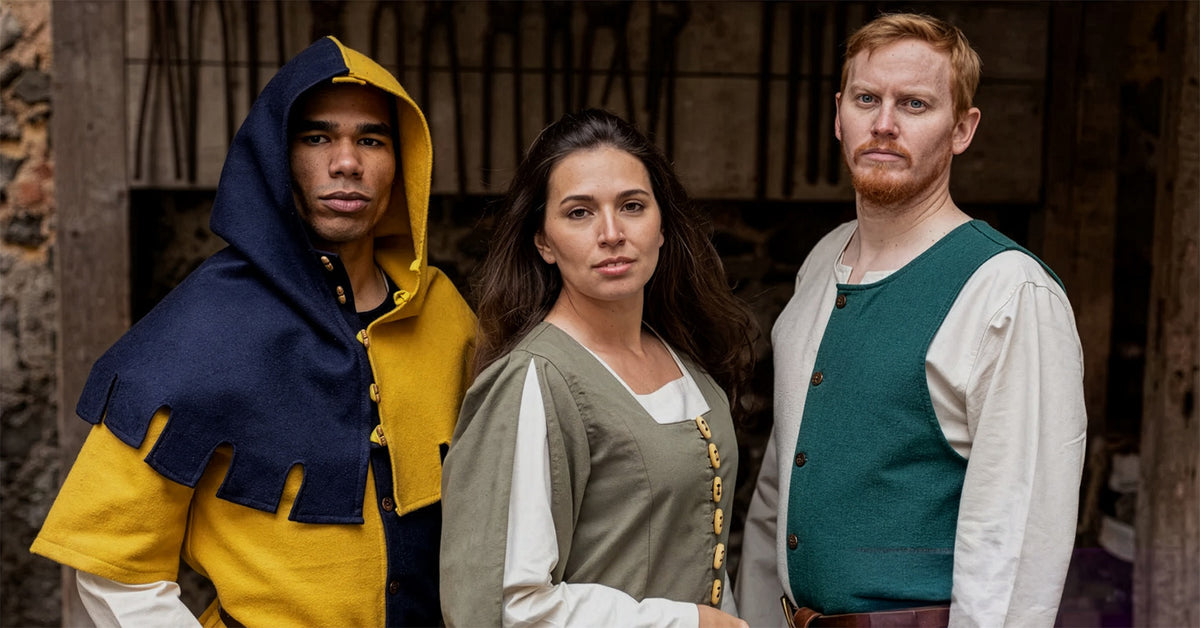
The Middle Ages encompasses an enormous time span in the history of mankind—from the 6th to the 15th centuries. Even though there is an enormous difference in the way people dressed during the various eras of the Middle Ages, throughout all strata of the European population it was common to wear clothing in layers that were often divided into outer- and undergarments. Because clothes in the Middle Ages were often used to recognize the wearer’s station in life and had therefore a more symbolic function, sumptuary laws decided which stratum was allowed to wear—or prohibited from wearing—a given kind of clothing. Their main goal was to prevent the peasantry from dressing in the kind of clothes the nobles fancied.
Differences in clothing in the middle ages
Sometimes clothing in the Middle Ages varied, due to the sumptuary laws and financial considerations. Not only the wearer’s station in life played a role here, but also gender, region, and the given sub-epoch within the Middle Ages. The fashion among the nobles for instance changed rather rapidly throughout the era, whereas the peasantry’s clothing remained more or less the same, since they had fewer resources at their disposal than did the rich and their clothes didn’t need to be stylish but rather practical.
Women’s garments had to be longer than those of men, as it was unseemly for them to reveal too much of their figure or undergarments. Yet this attitude was gradually set aside over the course of time during the Middle Ages. Also, married women were expected to cover their hair, a rule, that, however, declined in importance by the end of the Middle Ages, and as a consequence, women started wearing elaborate hairstyles and headdresses.
Medieval clothing today
Today, many people harbor a biased, overly generalized view of the Middle Ages, often ignoring significant differences among epochs or regions. Views on medieval clothing are commonly derived from movies in which the actors’ outfits aren’t based on historical facts. Since a lot of false information and myths circulate about the Middle Ages, the costumes are frequently changed to fit the story of the movie or simply are not carefully enough researched. In historical movies, the costuming ends up representing a random mixture of different epochs and regions, or even contains fantasy elements, creating an appealing style—but an inaccurate one.


